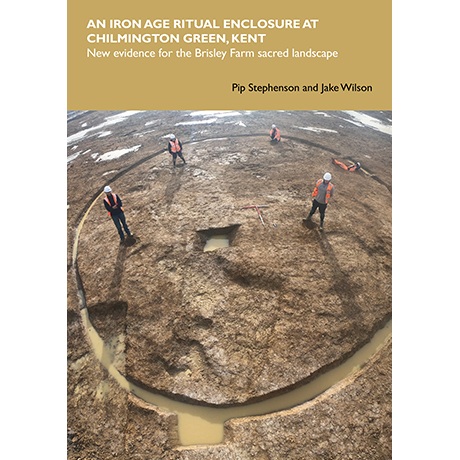
An Iron Age ritual enclosure at Chilmington Green, Kent: New evidence for the Brisley Farm sacred landscape.
Archaeology South-East’s 2019 excavations at Chilmington Green revealed a long-lived ritual landscape closely linked to nearby Brisley Farm. At its centre was a Middle to Late Bronze Age ring ditch, probably a barrow, which remained an important landmark for centuries. During the Iron Age, the monument was enclosed and increasingly formalised, mirroring developments at Brisley Farm, where shrines and high-status warrior burials created a major ritual centre. Although Roman reorganisation transformed the landscape, both sites retained sacred significance. Chilmington Green appears to have endured as a respected “place of memory”, reflecting the lasting power of ancestral monuments.
Detailed Description
Archaeology South-East’s 2019 excavations at Chilmington Green have revealed that this site and the nearby ritual complex at Brisley Farm formed part of a closely connected ceremonial landscape spanning more than a millennium. At its heart lay a Middle to Late Bronze Age ring ditch, probably the remains of a barrow, which remained a significant landmark long after its construction. Its importance is reflected in later Bronze Age and Early Iron Age land boundaries that carefully respected its position.
During the Middle and Late Iron Age, communities renewed their focus on this ancestral monument by enclosing it within a distinctive antennae enclosure, later replaced by a larger D-shaped enclosure. These developments mirror the emergence of the elite ritual centre at Brisley Farm, where shrines, ditched enclosures and two remarkable warrior burials dating to around AD 10 and AD 50 created one of the most significant Late Iron Age ceremonial complexes in Britain.
Although the Roman period brought major reorganisation through new field systems, older sacred places continued to shape the landscape. At Brisley Farm, ritual activity persisted around the warrior graves, while at Chilmington Green the enclosure appears to have remained a respected “place of memory” even after settlement shifted elsewhere. Its eventual decline may reflect changing social and political priorities.
Rare British parallels exist for such monuments, but comparable sites in continental Europe suggest that the reuse of ancient burial monuments was a powerful way for Iron Age elites to connect themselves with ancestral authority and reinforce emerging centres of power.
For all queries in regards to this product please contact the following :
louise.rayner@ucl.ac.uk